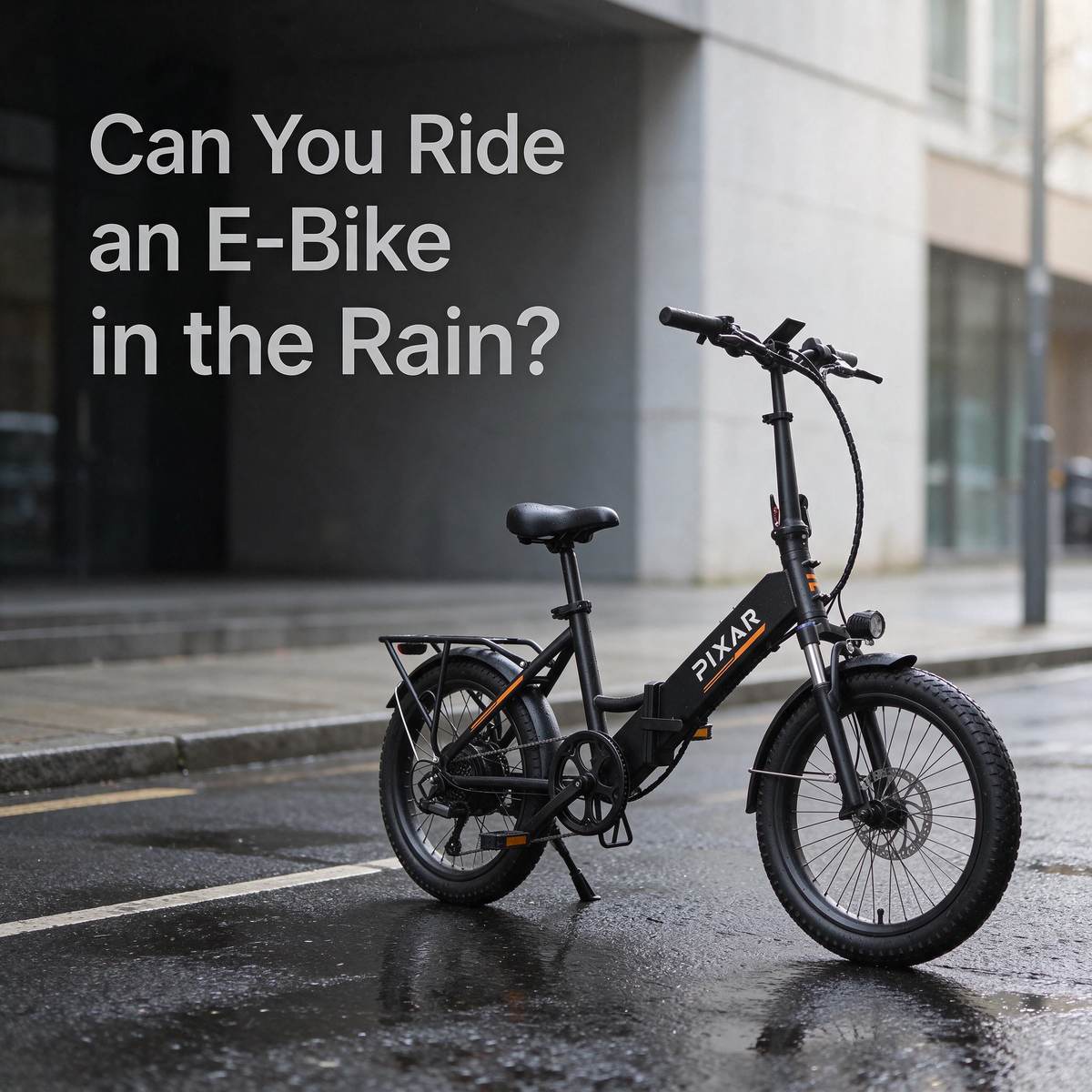


The best fat tire electric bike is the one that suits the routes you actually ride, not simply the one with the widest tires or the biggest battery. Before comparing models, think about where you will ride, where you will store the bike and whether you ever need to lift it. Tire size, total weight, brakes, battery capacity and the exact version sold in your country matter more than a headline range figure.
That last point is easy to overlook. A compact 20-inch fat tire e-bike and a larger trail-oriented model may both use four-inch tires, but they are not interchangeable. This guide explains what to compare and where the PIXAR M9 fits, including the trade-offs that may make it the wrong choice for some riders.

Which fat tire electric bike suits your riding?
| Your main use | Look for | Check before buying |
|---|---|---|
| Daily rides on pavement and bike lanes | Practical lighting, predictable handling and tires that make sense for paved routes | Overall width, weight, storage and local road-use documentation |
| Gravel and packed-dirt paths | Suitable tires, dependable brakes and a gear range for your hills | The maker’s stated use limits, total load and realistic range |
| Technical off-road trails | A bike designed and documented for that type of riding | Do not infer trail capability from tire width or suspension alone |
| Apartment stairs or frequent car loading | A substantially lighter bike or a practical loading solution | Ready-to-ride weight, battery weight and actual storage dimensions |
What to compare when choosing a fat tire e-bike
1. Wheel size and tire width
“Fat tire” does not tell you how a bike will feel. A 20-inch wheel makes for a compact format and can feel more responsive at low speeds. Larger wheels may suit longer, faster rolling routes better. Tire width affects air volume and the contact patch, but it does not make every bike suitable for sand, snow or technical trails.
Check the full tire size, such as 20 × 4 inches, and the maker’s intended-use guidance. Very wide tires can add bulk and rolling resistance on pavement. On gravel or packed dirt, they may offer a different feel under the rider, but tread, pressure, bike setup and rider technique still matter. Before changing pressure, use our guide to electric bike tire pressure and follow the limits printed on the tire fitted to your bike. A wide tire is not a substitute for a bike designed for demanding trail use.
2. Total weight and where you will keep the bike
Weight is easy to ignore during a test ride and hard to ignore when you reach a flight of stairs. Check the complete bike weight, not just the frame or battery. Include the weight of any rack, seat or other accessory you plan to use, and measure the narrowest doorway or storage opening.
PIXAR lists the M9 at 49.5 kg, with each of its two batteries listed at 5.5 kg. Removing the batteries helps when lifting, but it does not turn the bike into a lightweight model. The M9 makes more sense where it can be stored at ground level or loaded with suitable help than in a home where it must be carried upstairs every day.
3. Battery capacity and range claims
Compare battery energy in watt-hours (Wh), calculated by multiplying volts by amp-hours. Higher capacity can store more energy, but it does not guarantee a particular distance. Hills, temperature, wind, tire pressure, rider and cargo weight, and assistance level all affect range.
The M9 product page lists two 48 V, 17.5 Ah batteries, or about 1,680 Wh combined, and advertises up to 240 km in pedal-assist mode. Treat that as a manufacturer-stated figure, not a promise for every ride. Our guide to estimating electric bike range explains how to plan around route, load, temperature and assist level. Start with your normal round trip and leave a useful reserve rather than choosing a bike because its maximum advertised range barely covers the route.
4. Brakes, gears and after-sales support
A heavy bike needs brakes that are in good condition and suited to its setup. Check the brake type, rotor size, replacement-pad availability and where repairs can be handled. Gears can help you keep a comfortable cadence on climbs; they do not remove the need to choose an appropriate assistance level.
PIXAR lists hydraulic disc brakes, a Shimano seven-speed drivetrain and a rear hub motor on the M9. These are product specifications, not the result of an independent ride test. Our hydraulic vs mechanical e-bike brake guide explains the practical differences in lever feel, maintenance and use. Before ordering, read the warranty and support process: who diagnoses a fault, how replacement parts are supplied and what documentation is needed if a local shop carries out a repair?
5. Intended use and local road-use requirements
Do not assume that a “250 W” label, a 25 km/h top-speed figure or a CE mark by itself answers every road-use question. Check the documentation for the exact version sold in your country, including how assistance works, whether a throttle is fitted, and the motor’s rated and peak power. Local requirements and the delivered configuration both matter.
The M9 page lists a 25 km/h top speed and describes its rear hub motor as 250 W peak. It also lists a half-twist throttle, with a thumb throttle optional; the manual explains starting by pedalling before using the throttle. Those details are not enough to establish the road classification of every version sold across Europe. Ask PIXAR for the conformity documents that match the exact SKU and configuration before using it on public roads.
Where the PIXAR M9 fits
The M9 is a retro, moped-style fat tire e-bike with 20 × 4-inch tires. PIXAR lists a 250 W peak rear hub motor, 60 Nm of torque, two 48 V, 17.5 Ah batteries, hydraulic disc brakes, a Shimano seven-speed drivetrain and a bike weight of 49.5 kg. The manual describes a dual-suspension system and limits intended use to paved surfaces and light off-road riding, such as gravel or packed-dirt paths. It rules out extreme off-roading, jumps and stunts.
That makes the M9 worth considering if you want its moped-style format, wide tires and large stated battery capacity for paved rides and light paths within the manual’s limits. It is a poor fit if you need to carry the bike upstairs, fit it into a small car boot or ride technical trails. The listed price was €1,249 when checked; price, availability and included accessories can change.
The manual states a maximum gross load of 350 kg and a rear-rack limit of 25 kg. Do not read the gross-load figure as a rider weight limit. Ask PIXAR to confirm in writing what the total includes for your configuration, especially if rider weight, cargo or passenger accessories affect your decision.
Check the current configuration, colours and price on the PIXAR M9 product page. If you are specifically considering this retro format, see the retro e-bike collection. To compare other formats across the range, browse our electric bikes.
A practical checklist before you order
- Write down your usual route, surface, distance, hills and riding frequency.
- Measure your storage space and access route; compare them with the bike’s weight and dimensions.
- Compare battery capacity in Wh, not only the maximum range printed in a headline.
- Check brakes, replacement parts, warranty terms and the repair process in your country.
- Read the intended-use limits and confirm the road-use documentation for the exact configuration you will receive.
- Get any load limit that affects your decision clarified in writing.
Fat tire electric bike questions
Are fat tire electric bikes more comfortable?
Wide tires can change how a bike feels over some surfaces, but comfort also depends on tire pressure, saddle, riding position, wheels and suspension. Tire width alone does not guarantee a more comfortable ride on every route.
Is the PIXAR M9 suitable for technical trails?
No. The M9 manual describes paved surfaces and light off-road use, including gravel and packed dirt. It excludes extreme off-roading, jumps and stunts. Follow the manual rather than judging trail suitability from the tire width.
Is the PIXAR M9 easy to lift or transport?
Not if you need to lift it often. PIXAR lists the bike at 49.5 kg. Each battery is listed at 5.5 kg, so removing them reduces the load but still leaves a heavy bike. Check the dimensions and loading method before buying for apartment stairs or regular car transport.
Can the M9 travel 240 km on every charge?
No. The 240 km figure is a range claim published by PIXAR, not a guarantee for every ride. Terrain, temperature, wind, tire pressure, cargo and assistance level can all reduce the distance. Use it as a maker’s reference figure and plan around your actual route.
Can I ride any fat tire e-bike on public roads in Europe?
Do not assume that every model or configuration has the same road classification. Check the documentation for the exact bike sold in your country, including whether a throttle is fitted and how assistance operates. For the M9, ask PIXAR for the conformity documents matching the SKU and configuration you will receive.
What does the M9’s 350 kg maximum gross load mean?
The manual lists 350 kg as maximum gross load and 25 kg for the rear rack. Gross load should not be treated as the maximum rider weight. Ask PIXAR to confirm what is included in the figure for your configuration, including rider, cargo and accessories.