

Choose an electric bike that fits your route, your body and your storage space. A long-range battery is little comfort if you cannot get the bike through your front door or safely up the stairs. If you are asking “which e-bike fits me”, check those everyday constraints first, then compare the frame, motor, battery and road requirements.
Key Questions to Decide Which E-Bike Fits Me
Start with the journey you ride most often and the space where you will keep your e-bike.
- Route: Note your return distance, hills, surface and the luggage you carry. A short city ride has different demands from a hilly commute.
- Riding position: Check your reach to the handlebars, access to the brakes and confidence when stopping. Try mounting and dismounting, ideally on a test ride.
- Storage: Measure doorways, lifts and the parking space. If you live upstairs, consider how you will move the complete bike and where you can charge it.
A removable battery may make charging easier, but it does not solve the problem of carrying the bike upstairs.
What to Consider When Buying an E-Bike
When buying an e-bike, prioritise comfortable fit, safe load capacity and access to repairs.
Check the permitted total weight. This generally includes the bike, rider, luggage and accessories. For example, a 140 kg limit minus a 110 kg bike-and-rider combination leaves 30 kg for luggage and accessories, subject to separate rack limits. Use your chosen model’s actual figures.
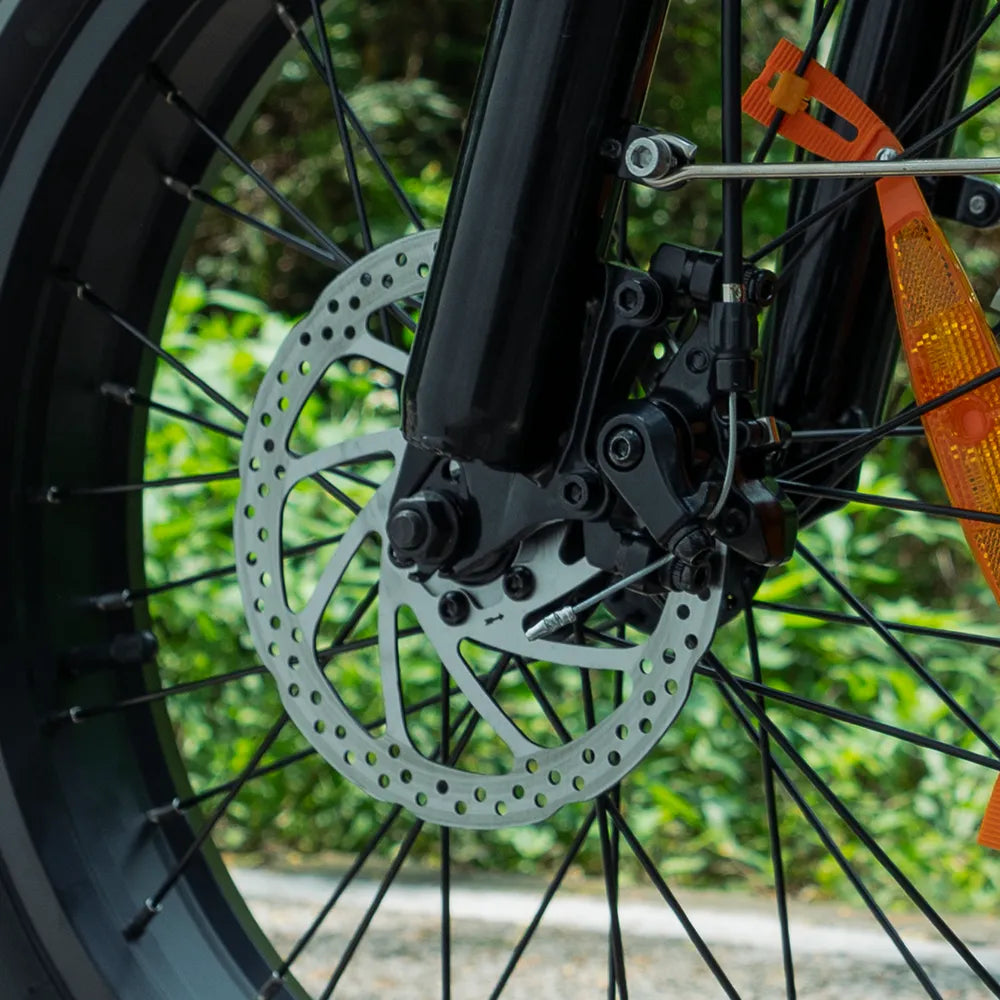
Choose brakes you can control. Hydraulic disc brakes can require less lever effort; well-maintained mechanical disc brakes can also be suitable. Try the levers, consider your route and load, and ask a workshop about servicing.
Ask about repairs before buying. Find out who can service both the mechanical parts and electrical system, and how to obtain a replacement battery.
Comparing the Main Types of Electric Bikes
The main types of electric bikes differ in how they handle daily travel, storage and cargo.
City E-Bikes
City e-bikes suit frequent stops and paved commuting. A low-step frame makes mounting easier, while lights, mudguards and a rack can make daily trips more practical.
The PIXAR C1 has a low-step frame, removable battery and enclosed chain guard. The PIXAR C1 Pro adds hydraulic disc brakes; check each model’s fit and included equipment against your commute.

Folding E-Bikes
Folding e-bikes can save floor space or help with a train-and-bike journey. Compare the folded dimensions with your doorway, lift or car boot, and check the transport operator’s rules. A folded bike still needs to be handled: confirm its weight and try lifting it.
The PIXAR Rusher is a folding model with 7-speed gearing and mechanical disc brakes. Confirm its current folded dimensions before measuring your space.

Touring E-Bikes
Touring e-bikes suit longer rides and mixed paved routes. Look for a comfortable position, suitable gearing and enough battery capacity for the distance between charging stops.
The PIXAR Largo is a touring e-bike with a 250 W rear motor and a 36 V, 15.8 Ah battery. Compare its fit and charging capacity with your planned route, including the return trip.

Cargo E-Bikes
Cargo e-bikes are designed for carrying larger loads. Check the permitted total weight and individual rack limits, then consider whether you can park, turn and store the loaded bike. For passengers, check the bike’s approved equipment and local rules.
Understanding E-Bike Motor and Battery Specs
E-bike motor and battery specs matter most when matched to your hills, preferred pedalling feel and charging routine.
Hub Motors vs Mid-Drive Systems
A hub motor drives the wheel; a mid-drive motor delivers assistance through the drivetrain.
| Motor | How it works | What to consider |
|---|---|---|
| Rear hub | Drives the rear wheel without sending motor force through the chain | Compare the motor’s response and performance on your route. |
| Mid-drive | Drives through the bike’s gears | Lower gears can help on climbs; the drivetrain carries additional load. |
Torque, measured in newton metres (Nm), describes turning force. It helps compare motors, but gearing, total load and assistance tuning also affect hill performance.
Cadence Sensors vs Torque Sensors
The sensor determines which pedalling input the motor responds to:
- Cadence sensor: Detects pedal rotation and signals the motor to assist.
- Torque sensor: Measures pedalling effort and adjusts assistance in response.
Try both on a test ride if possible; the tuning of each bike also affects how assistance feels.
Calculating Battery Capacity in Watt-Hours
Watt-hours (Wh) describe nominal battery energy: multiply voltage by amp-hours. For example, 36 V × 18 Ah = 648 Wh. Compare Wh rather than amp-hours alone.
A larger battery can support longer rides under comparable conditions, but an advertised maximum is not guaranteed. Hills, wind, temperature, rider and luggage weight, and assistance level all affect range. Leave a margin for your full journey.
Understanding E-Bike Legal Speed Limits and Safety Standards
E-bike legal speed limits determine the vehicle category and can change where you may ride.
Standard Pedelecs and Speed Pedelecs
Under EU Regulation 168/2013, a pedal-assisted cycle is excluded from that regulation’s motor-vehicle type-approval scope when its maximum continuous rated power is no more than 250 W and assistance progressively cuts off before 25 km/h and when pedalling stops.
In Germany, a standard pedelec meeting the applicable requirements is generally treated as a bicycle. A speed pedelec assisting up to 45 km/h is a different category: it requires a suitable licence, insurance plate and helmet, and cycle-path use is restricted. Check rules in the country where you ride.
Road Equipment and Brakes in Germany
Germany’s StVZO lighting rules cover lights and reflectors. Compliant lights can use a battery or dynamo; they need not all be wired to the main battery. Check the prescribed equipment and two independently functioning brakes before using public roads.
Managing E-Bike Weight and Daily Storage Realities
E-bike weight and storage can determine whether you use the bike comfortably every day.
Removable Batteries and Charging Access
A removable battery can simplify charging when the bike stays in a ground-floor storage room. Check where you will charge it and follow the battery instructions for temperature and charger use. A cold battery may need to warm to its specified charging range first.
Moving a Bike Through Tight Spaces
Confirm the complete bike’s weight, including whether the battery is counted, and test the difficult part of the route into storage. Removing the battery may reduce the lift. Walk assist, if fitted, can help on a suitable ramp but does not carry the bike up stairs.
Which E-Bike Fits Me for Long-Term Value?
The e-bike that fits you for long-term value is one you can maintain, charge and secure.
Compare the purchase price with the costs and support you will need afterwards:
- Security and accessories: Allow for a suitable lock and any equipment not included.
- Maintenance: Budget for servicing, tyres and brake pads; ask a workshop whether it handles both electrical and mechanical repairs.
- Battery and warranty: Check replacement battery availability, warranty exclusions and the repair process before ordering.
Essential Pre-Purchase Checklist
Before ordering, check these points against your own route and home:
- Measure the storage space, entrances and any folded-bike opening.
- Confirm the bike’s weight and practise the necessary lift or manoeuvre.
- Check fit, brake reach, mounting and stopping.
- Add bike, rider and cargo weights; compare them with the stated limits.
- Compare battery Wh and charging options with the complete journey.
- Check local road requirements, included equipment and repair support.
Final Words
Choose your electric bike in the order you will use it: get it out of storage, ride your usual route, then put it away and charge it. Measure your space, check fit and load, and compare battery capacity with your return journey. Confirm local road requirements and service support before buying.
Frequently Asked Questions
How do I know which e-bike fits me best?
Match the bike to your usual route, body and storage space. Test the fit and controls, then check its weight, dimensions and permitted load.
What should I consider when buying an e-bike on a budget?
Prioritise fit, suitable brakes, road equipment and repair support. Include the cost of a lock, servicing and any essential accessories.
Can I ride an e-bike in the rain safely?
Yes, many e-bikes are designed for ordinary wet-weather riding. Check your model’s instructions, slow down and leave extra braking distance; avoid immersing electrical components.
Is a 250 W motor powerful enough for steep hills?
Yes, a 250 W motor can assist on steep hills, but performance depends on gearing, torque, load and rider effort. Test a bike on a comparable slope if possible.