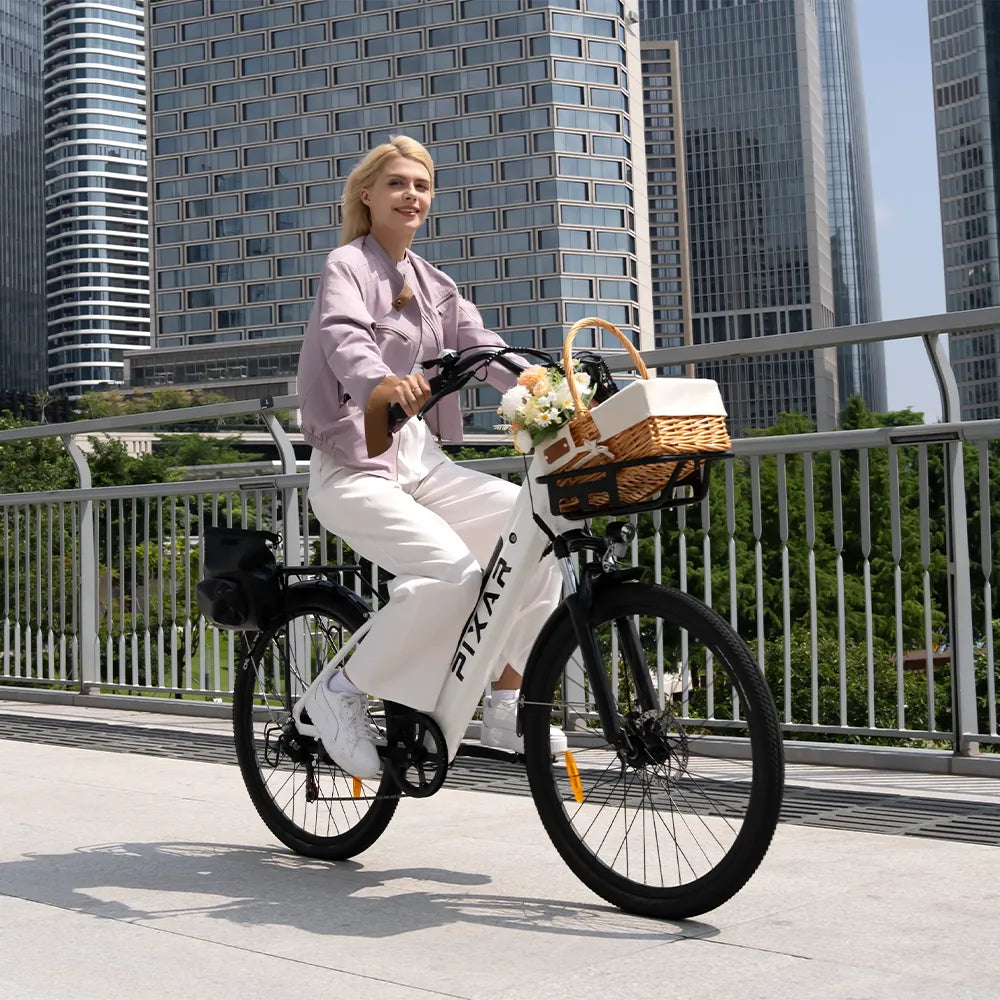


For many riders over 60, the moment that decides whether an e-bike works is not out on the open road. It is the moment of getting on and off at a junction, with a bag on the rack and one foot that needs to reach the ground before the bike starts to lean.
E-bikes for women over 60 are usually sold on motor power and headline range. Those figures matter less than four other things: how easily you can get on and off, how stable the bike feels below walking pace, how controllable the brakes are in your hands, and how manageable the bike is when you are not riding it.
This guide works through those factors in order, then covers how much riding counts towards published activity targets, a six-point fit check you can run in a shop, and what EU rules actually define as a bicycle rather than a motor vehicle.
4 Factors Behind Choosing E-Bikes for Women Over 60
Suitability for a rider over 60 is decided by frame access, low-speed stability, brake control, and off-the-bike handling. Motor output and battery size only become relevant once those four are settled.
The reason is simple. Most difficult moments on a city e-bike happen at low speed or at a standstill, where the motor is not helping and the weight of the bike is working against you rather than with you.
Use these four dimensions as your comparison structure:
- Frame access — how high you must lift your leg to mount and dismount.
- Low-speed stability — how the bike behaves between zero and walking pace.
- Brake control — how much hand force is needed for a controlled stop.
- Off-the-bike handling — pushing, parking, lifting, and storing.
Everything else, including range, torque, gearing, and accessories, should be compared after you have a shortlist that passes all four.
Is a more powerful motor better for an older rider?
Not usually. A higher-output motor raises the speed at which you reach the moments that are hardest to manage, and in the EU a pedal-assisted cycle is only treated as a bicycle rather than a type-approved motor vehicle when its continuous rated power stays at or below 250 W.
E-Bikes for Senior Women and Weekly Physical Activity Targets
E-bikes for senior women can contribute meaningfully to published weekly activity targets, but they do not cover all of them. Knowing which part e-cycling covers helps you decide how often you would need to ride for the purchase to be worth it.
The World Health Organization recommends that adults aged 65 and over do “at least 150–300 minutes of moderate-intensity aerobic physical activity” each week, and separately that they “do varied multicomponent physical activity that emphasizes functional balance and strength training at moderate or greater intensity, on 3 or more days a week, to enhance functional capacity and to prevent falls.” Riders aged 60 to 64 fall under the adult recommendation, which uses the same 150–300 minute aerobic range.
A 2022 systematic review with meta-analyses by Riiser and colleagues in Frontiers in Sports and Active Living examined e-cycling and health outcomes across eight trials and two cohort studies.
The authors report that e-cycling is less intensive than conventional cycling but that “the intensity is still within” the range associated with health benefits, and they found improvements in maximal oxygen consumption and maximal power output. Summarising earlier work by Bourne and colleagues, they note oxygen consumption between 51% and 73% of VO2max during e-cycling.
In practice, three rides of roughly 50 minutes a week reaches the lower end of the 150-minute aerobic target. That is a useful planning figure when you are deciding between a bike you will ride twice a month and one you will ride on the way to the shops.
Two honest limits apply. The studies above were not conducted specifically on women over 60, so the intensity figures are indicative rather than personalised. And cycling does not substitute for the functional balance and strength training that the 65+ guidance asks for on three or more days a week, which generally needs separate work.
The Step-Through E-Bike for Senior Women and When It Helps
A step-through e-bike for senior women is worth choosing when the day involves repeated stops, reduced hip or knee range of motion, everyday clothing, or a loaded rear rack. A step-through frame is one with a lower frame opening, so mounting does not require swinging a leg over a high top tube.
The benefit is concentrated in a specific moment. On a high-top-tube frame with a rack, a pannier and a basket, the leg swing has to clear all of it, and that swing is performed while balancing on one leg beside a bike that may weigh more than a non-assisted bicycle.
A low frame opening also changes how you can stop. Being able to step forward off the saddle and stand flat-footed on the ground, rather than tipping the bike towards you to reach down, gives you a more predictable recovery when a stop is unplanned.
That said, a step-through label is not a fit measurement. Standover height still varies between step-through models, and a frame can have a low opening while placing the handlebars too far forward for comfortable control. The frame style narrows the shortlist; the fit check decides it.
Among PIXAR’s range, the C1, C1 Pro, and Cruiser all use low step-through frames on 27.5-inch wheels, which the product pages present as easier to mount and dismount. Treat that as a starting point for a shortlist and confirm fit on the specific bike.

Low Step-Through Frames for Shorter Riders
Shorter riders should treat standover clearance and minimum saddle height as two separate measurements. A low frame opening tells you that you can stand over the frame; it says nothing about whether the saddle can be lowered enough to set a comfortable pedalling height, and a bike can pass the first check while failing the second.
Wheel diameter is not a reliable proxy for fit either. The C1, C1 Pro, and Cruiser use 27.5-inch wheels while the folding Rusher uses 20-inch wheels, but it is seat-tube length, the lowest usable saddle position, and reach to the handlebars that decide whether a bike fits you. Ask for those three figures before ordering any bike you cannot try in person.
6 Point Fit Check Before Buying an E-Bike for Women Over 60
Run these six checks on any e-bike for women over 60 before you compare specifications, ideally with the bike stationary or moving at walking pace. Each one targets a situation where a mismatch tends to show up only after purchase.
- Stand over the frame in normal shoes. Both feet should be flat on the ground with the bike upright, without you leaning it to one side.
- Set the saddle to your riding height, then stop as you would at a light. Slide forward off the saddle and check that you can hold the bike steady with one foot down.
- Check the reach to the handlebars. Elbows should stay slightly bent with relaxed shoulders. If you must lock out your arms or round your back, the reach is wrong for you.
- Squeeze both brake levers with the hand you would actually use. You should reach full braking force without stretching your fingers or gripping at maximum strength.
- Ride a slow figure of eight in a car park. Low-speed turning reveals unstable steering and awkward weight distribution far better than a straight-line test ride.
- Push the bike ten metres with the motor off, then lift the front wheel over a kerb. This is what parking, manoeuvring in a garage, and getting through a doorway will feel like every day.
Each check maps back to one of the four factors above: checks 1 and 2 to frame access, check 3 to fit, check 4 to brake control, check 5 to low-speed stability, and check 6 to off-the-bike handling. A bike that fails any of them is not repaired by a larger battery or a higher torque figure.
FURTHER READING: How to Pick the Perfect Electric Bike for Women
Frame Access Versus Manageable Weight on an E-Bike for Senior Women
An easy-to-mount frame does not make an e-bike for senior women easy to handle when you are off it. Weight becomes the limiting factor during pushing, parking, lifting onto a car rack, and moving the bike through a hallway or lift.
This distinction matters because e-bikes carry a battery, a motor, and reinforced frame tubing that a conventional bicycle does not. A bike that feels stable and planted while riding can be the same bike that is difficult to reposition in a shed.
Removable Battery and Folded Size on an E-Bike for Senior Women
Two options change how an e-bike for senior women behaves off the bike, and they solve different problems. A removable battery reduces the mass you actually lift, because the heaviest single component comes off before you move the bike, and it also lets you charge indoors without bringing the bike inside. The C1, C1 Pro, and Cruiser product pages all list a removable battery.
A folding model solves space rather than weight. The PIXAR Rusher is listed with folded dimensions of 84 × 51 × 79 cm, which is a figure you can measure against a car boot, a lift, or a storage cupboard before deciding. Folding reduces the footprint and not the mass, so it does not confirm that you can lift the bike into a vehicle once it is folded.
One caution on published weights. Retailer shipping-weight fields describe a packed carton, not the assembled bicycle, so ask the seller for the confirmed net weight of the complete bike and of the battery alone before you rely on either number.

Range, Torque and Assist Levels for E-Bikes for Women Over 60
Range and torque should be matched to the route you will actually ride, not to the largest figure on a product page. An official maximum range is a model-specific claim measured under favourable conditions; it is useful for comparing models and unreliable as a prediction for any individual rider.
Planning Range for Daily Errand Riding
Start from your round trip rather than the one-way distance, then add a buffer for hills, headwinds, cold weather, cargo, and higher assist levels. If you can only charge at home, that buffer needs to be larger than it would be for someone who can charge at a destination.
PIXAR’s official stated maximum range figures are up to 120 km for the C1, up to 150 km for the C1 Pro, and up to 120 km for the Cruiser. For a leisure or errand rider covering 15 to 25 km in a day, all three leave a substantial margin, which is often more relevant than the difference between them.
Torque and Assist Levels for Everyday Riding
Torque is the turning force delivered at the wheel, measured in newton-metres, and it describes pulling away from a standstill and climbing better than motor wattage does. The C1, C1 Pro, and Cruiser are each listed with 45 Nm of maximum torque and a 250 W rear motor, and the product pages state a maximum gradient of 35 degrees and a maximum load of 250 kg.
Assist levels are the control that most new riders underuse. PIXAR’s city models offer assistance across levels 0 to 5, and treating that as an effort dial rather than a comfort setting lets you increase your own contribution gradually as fitness returns, or drop a level on the last hill of a longer ride instead of cutting the ride short.
How much range does a rider over 60 actually need?
Enough for the full round trip plus a buffer for terrain, weather, and assist use. For most errand and leisure riding this is well under any current official maximum claim, so range is rarely the deciding factor between city models.
EU Rules That Define an E-Bike for Senior Women
No separate EU category exists for an e-bike for senior women; the same rules apply to every pedal-assisted bicycle sold in Europe. Such a bicycle is excluded from motor-vehicle type-approval when it meets specific technical limits, and those limits explain the specifications you see on European e-bikes. Regulation (EU) No 168/2013 excludes from its scope:
“pedal cycles with pedal assistance which are equipped with an auxiliary electric motor having a maximum continuous rated power of less than or equal to 250 W, where the output of the motor is cut off when the cyclist stops pedalling and is otherwise progressively reduced and finally cut off before the vehicle speed reaches 25 km/h”
Three consequences follow for a buyer. Assistance stops when you stop pedalling, the motor tapers off before 25 km/h rather than cutting out abruptly, and 250 W of continuous rated power is the ceiling for a machine treated as a bicycle at EU level. PIXAR’s C1, C1 Pro, Cruiser, and Rusher are all listed at 250 W with a 25 km/h assistance limit.
This also explains why much of the English-language buying advice for senior riders does not transfer. Guides written for the United States routinely recommend 750 W motors and throttle-operated models, neither of which fits the EU definition above.
The regulation defines the vehicle category, not the conditions of use. Helmet requirements, minimum age, insurance, and access to cycle paths and shared routes are set nationally and vary between member states, so check your national road-traffic authority before relying on any general statement. The EU definition itself sets no upper age limit for riding a pedal-assisted bicycle.
PIXAR Step-Through Models for Riders Over 60
Compare PIXAR’s models by what constrains your riding rather than by specification totals. The C1, C1 Pro, and Cruiser use low step-through frames; the Rusher appears here as the folding option for riders whose limit is storage.
| Main constraint | Model | Key published feature |
|---|---|---|
| Everyday city riding | C1 or Cruiser | Up to 120 km stated range |
| Grip or hand strength | C1 Pro | Hydraulic disc brakes |
| Storage or car transport | Rusher | Folds to 84 × 51 × 79 cm |
The C1 pairs a low step-through frame with a removable 36V 13Ah battery, Shimano 7-speed gearing, an adjustable and lockable front fork, and a fully enclosed chain guard that reduces the risk of catching a trouser leg or skirt hem. Its standard configuration includes a rack and mudguards, with front, rear, or twin baskets available as options.
The C1 Pro adds a 36V 18Ah Samsung battery, a BAFANG rear motor, a unibody frame without visible welds, and hydraulic disc brakes, which the product page describes as delivering more consistent braking force in all weather. The lower lever force typically required by hydraulic brakes is worth weighing if hand strength or grip is a consideration.
The Cruiser uses a 36V 12.8Ah removable battery and slightly wider 27.5 × 2 inch tyres, with a lockable adjustable front fork and a transverse rear suspension unit in the middle of the frame. It ships as bike, rack, and mudguards, with basket combinations as options.
Price, colour, stock, included accessories, and any current promotion change over time. Check the relevant product page on the day you buy rather than relying on figures quoted in any guide, including this one.
Frequently Asked Questions
Are E-Bikes Safe for Women Over 60?
E-bikes can be a suitable option for riders over 60 when the bike fits, the brakes are controllable with the rider’s hand strength, and the rider is confident at low speed. Frame access, standover clearance, and stopping control matter more than motor specifications. Riders with balance, joint, cardiac, or vision concerns should discuss cycling with their doctor before buying.
What Is the Best Type of E-Bike for Senior Women?
The best type of e-bike for senior women is usually a low step-through city model with an upright riding position, suited to riders who stop frequently and ride in everyday clothing. A folding model becomes the better choice when storage space, a lift, or car transport is the binding constraint. Choose the category from your daily constraints first, then compare models within it.
Do You Need a Licence or Insurance for an E-Bike in the EU
Licence, registration, and insurance obligations in the EU attach to motor vehicles, and Regulation (EU) No 168/2013 excludes a pedal-assisted cycle from that category when the motor is rated at 250 W or less and assistance cuts off before 25 km/h. Helmet rules, minimum age, and any local insurance requirement are set nationally and differ between member states. Confirm the current rules with your national road-traffic authority before riding.
How Far Can an E-Bike for Senior Women Realistically Go
Realistic distance depends on rider weight, assist level, terrain, temperature, tyre pressure, and stop-start riding, so a published maximum should be read as a comparison figure rather than a guarantee. PIXAR lists official maximum ranges of up to 120 km for the C1 and Cruiser and up to 150 km for the C1 Pro. Plan around your round-trip distance plus a buffer.
Is a Step-Through Frame Always Better for Older Riders
A step-through frame helps most when mounting, dismounting, and stopping are frequent or difficult, but it does not guarantee a good fit on its own. Standover height, reach, saddle-height range, and brake-lever reach still vary between step-through models. Run the six-point fit check on the specific bike rather than relying on the frame category.
The Bottom Line
Choosing among e-bikes for women over 60 is a fit and control decision before it is a specification decision. Frame access, low-speed stability, brake control, and off-the-bike handling determine whether a bike gets ridden; range and torque determine only how far and how easily it climbs once those four are settled.
Set the shortlist with a low step-through frame if you stop often or ride in everyday clothing, then run the six-point check in person. Confirm the national rules that apply where you ride, and read the current product page for price, colour, stock, and included accessories on the day you buy.
If regular riding is part of the reason for the purchase, three rides of about 50 minutes a week reaches the lower end of the 150-minute weekly aerobic target published by the WHO. Plan the routes that make that realistic, and let the bike follow from the route rather than the other way round.